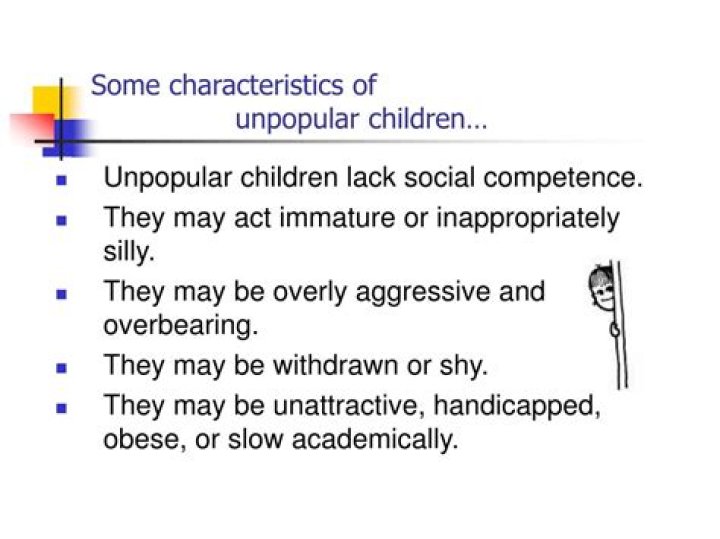
What makes a child popular or unpopular?
Although there are myriad reasons why
children become
unpopular, the main cause is a lack of social skills and parental guidance. Other reasons include childhood disorders, abuse and family issues. Parents, if you have an
unpopular child, you should take it very seriously.
Which characteristic does a popular child have?
Popular children receive many positive and few negative nominations. They are well liked by others.
Popular children are cooperative, sociable, friendly, and sensitive to others. Although they are assertive and capable of using aggression, they exhibit few disruptive and negative behaviors.
Are unpopular kids more successful?
A quarter (25%) said
popular kids are
more successful in their post-high school lives than
are unpopular kids. Twenty-four percent volunteered that both groups are probably equally
successful.
What do you do when your child is the weird kid?
- Teach your child that there’s a time and place to let their “freak flag fly”. I’ve learned to strike deals with Anna.
- Try not to make your child feel any weirder than they already are.
- Recognize that the current strange stage is just that–A stage.
- Don’t try to change them.
- Don’t try and over-explain your kid to others.
When should I be concerned about my child’s behavior?
Perhaps the most important question of all for parents of school-age children to consider is, “How much distress is your
child’s problem causing you, the
child, or other members of the family?” If a
child’s aggressive or argumentative
behaviors, or sad or withdrawn
behaviors are seen as a problem for a
child, the
What is a quirky kid?
A
quirky child experiences difficulty fitting in and connecting with others usually due to an interpersonal style or behavior that stands out from the other
kids. Maybe they are obsessed with a topic of interest or spend excessive hours a day reading, playing video games, or playing with just one toy.
Is smelling everything a sign of autism?
One paper last year suggested that children with
autism experience
smells more intensely than their typical peers do, but another found no such difference. The new study suggests both that
smell is impaired in children with
autism and that their altered response to
odors is tied to their social deficits.
Why is your child special to you?
Every
child has
unique character strengths and abilities that allow him or her to express their individuality in a social environment. It is what makes them “
special”. When trying to understand
your children and their behavior,
you can think of them as being the sum of all the parts that make them
unique.
What is quirky behavior?
Eccentricity (also called
quirkiness) is an unusual or odd
behavior on the part of an individual. This
behavior would typically be perceived as unusual or unnecessary, without being demonstrably maladaptive. People who consistently display benignly eccentric
behavior are labeled as “eccentrics.”
How is your child different from others?
Some
children are a little quirky and quite
different from other
children their age. They may be creative, insightful, and courageous, but they also may have to struggle with peer rejection, loneliness, taunts, and frustration.
Their behavior may overshadow family events or make
their siblings irritable.
What are personality quirks?
Character
quirks are the memorable little things about a character’s
personality that make them charming, endearing, weird, or unique. A
quirk is anything worth describing about a character. Maybe a character touches their hair when they’re nervous, or maybe they always sing to their houseplants in the morning.
Is being eccentric considered a mental illness?
People with schizotypal personality
disorder have odd behavior, speech patterns, thoughts, and perceptions. Other people often describe them as strange or
eccentric. People who have this
disorder may also: Dress, speak, or act in an odd or unusual way.
What mental disorder makes you act like a child?
Munchausen syndrome by proxy (also known
as factitious
disorder imposed on another) is where
you act like the person
you‘re caring for (a
child, a disabled individual, or an older person, for example) has a physical or
mental illness while the person is not actually sick.
What is borderline personality syndrome?
Borderline personality disorder is an illness marked by an ongoing pattern of varying moods, self-image, and
behavior. These symptoms often result in impulsive actions and problems in relationships.
Is fantasizing a mental illness?
What is maladaptive
daydreaming? Maladaptive
daydreaming is a
psychiatric condition. It was identified by Professor Eliezer Somer of the University of Haifa in Israel. This condition causes intense
daydreaming that distracts a person from their real life.
What does maladaptive daydreaming look like?
Symptoms of
maladaptive daydreaming may include: Intense, vivid
daydreams that present
as a story, with characters, settings, and plotlines.
Daydreams that
are triggered by real-world events or sensory stimuli. Unconscious facial expressions, repetitive body movements, or talking or whispering that accompany
daydreams.
Is maladaptive daydreaming a symptom of depression?
“
Daydreaming can be an indication that someone is suffering from concentration difficulty, which is seen in many
mental illnesses, including
depression,
anxiety, post-traumatic stress disorder, and attention deficit hyperactivity disorder,” says Lauren Cook, a therapist and author based in San Diego.
Is daydreaming a sign of trauma?
Maladaptive
daydreaming usually occurs as a coping mechanism in response to
trauma, abuse or loneliness. Sufferers create a complex inner world which they escape to in times of distress by
daydreaming for hours.
Can maladaptive daydreaming be self diagnosed?
Diagnosis. It is not currently possible to formally
diagnose maladaptive daydreaming. Experts did develop a 14-point
Maladaptive Daydreaming Scale to help people determine whether or not they are experiencing symptoms of it.
How common is maladaptive daydreaming?
In the Somer and colleagues (12) study, the frequency of dissociative disorders in the sample of
maladaptive daydreaming participants was 12.8%. Based on our clinical experience, however, we thought that
maladaptive daydreaming might be quite
common in dissociative identity disorder.
What kind of trauma causes maladaptive daydreaming?
Childhood exposure to physical and emotional abuse was associated with an increased likelihood of
daydreaming about an idealized version of their original families. Themes of emotional suffering were associated with exposure to childhood emotional abuse.
What is maladaptive behavior?
Maladaptive behaviors are those that stop you from adapting to new or difficult circumstances. They can start after a major life change, illness, or traumatic event. It could also be a habit you picked up at an early age. You can identify
maladaptive behaviors and replace them with more productive ones.
 Matthew Martinez