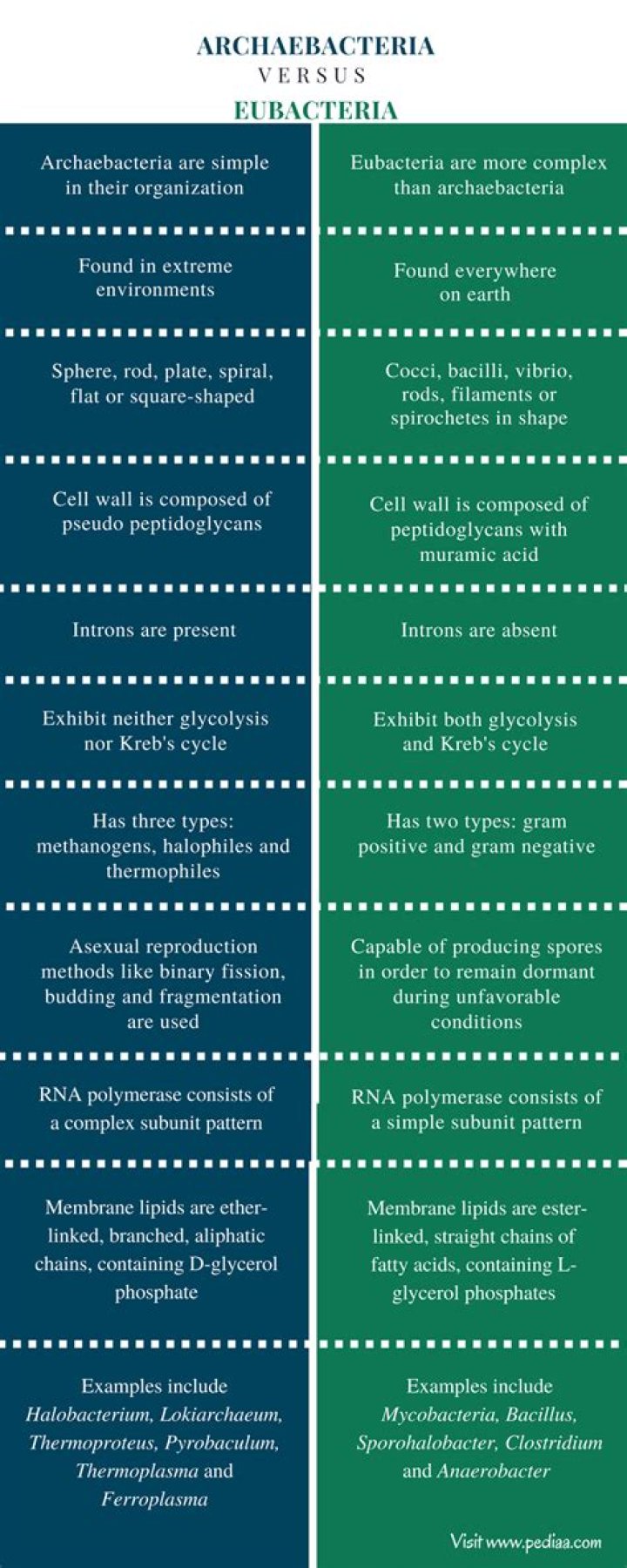
What are 3 differences between bacteria and archaea?
Responses will vary. A possible answer is:
Bacteria contain peptidoglycan in the cell wall;
archaea do not. The cell membrane in
bacteria is a lipid bilayer; in
archaea, it can be a lipid bilayer or a monolayer.
Bacteria contain fatty acids on the cell membrane, whereas
archaea contain phytanyl.
What are the main differences between archaea bacteria and eukarya?
Archaea: cells do not contain a nucleus; they have a different cell wall from
bacteria.
Eukarya: cells do contain a nucleus.
How can you distinguish between archaea and bacteria?
Bacterial cell walls contain peptidoglycan. Archaean cell walls do not have peptidoglycan, but they may have pseudopeptidoglycan, polysaccharides, glycoproteins, or protein-based cell walls.
Why are archaebacteria and eubacteria in different kingdoms?
Like
archaebacteria,
eubacteria are complex and single celled. Most bacteria are in the
EUBACTERIA kingdom. They are the kinds found everywhere and are the ones people are most familiar with.
Eubacteria are classified in their own
kingdom because their chemical makeup is
different.
What do eubacteria and archaebacteria have in common?
Eubacteria and archaebacteria are the only prokaryotes found on earth. They
have a
common progenitor cell but different evolutionary lines.
Do bacteria
have a nucleus? Both eubacterial and archaeal cells lack a nucleus and other membrane-bound organelles.
What are the 3 main domains of life?
This phylogeny overturned the eukaryote-prokaryote dichotomy by showing that the 16S rRNA tree neatly divided into
three major branches, which became known as the
three domains of (cellular)
life: Bacteria, Archaea and Eukarya (Woese et al. 1990).
Are there two or three domains of life?
Summary. That Bacteria, Archaea and Eukarya (eukaryotes) represent
three separate
domains of Life, no one having evolved from within any other, has been taken as fact for
three decades.
Why do we use the three domain system?
The
Three Domain system is based on modern molecular evidence, and uses the category
Domain as a Superkingdom to emphasize the extremely ancient lineages that exist among prokaryotes and protista, and the relatively recent relationships of multicellular organisms.
What are the 3 domains of life and what are the major differences?
The
three-domain system is a biological classification introduced by Carl Woese et al. in 1990 that divides cellular
life forms into archaea, bacteria, and eukaryote
domains. The key
difference from earlier classifications is the splitting of archaea from bacteria.
What are the 3 domains and examples?
According to this system, the tree of life consists of
three domains: Archaea, Bacteria, and Eukarya. The first two are all prokaryotic microorganisms, or mostly single-celled organisms whose cells have a distorted or non-membrane bound nucleus.
What are the 3 domains of life give examples?
The
three domains are the Archaea, the Bacteria, and the Eukarya. Prokaryotic organisms belong either to the
domain Archaea or the
domain Bacteria; organisms with eukaryotic cells belong to the
domain Eukarya.
What are the 3 types of domain?
There are
three domains of life, the Archaea, the Bacteria, and the Eucarya. Organisms from Archaea and Bacteria have a prokaryotic cell structure, whereas organisms from the
domain Eucarya (eukaryotes) encompass cells with a nucleus confining the genetic material from the cytoplasm.
What is domain name give examples?
Domain names are used to identify one or more IP addresses. For
example, the
domain name microsoft.com represents about a dozen IP addresses.
Domain names are used in URLs to identify particular Web pages. For
example, in the URL the
domain name is pcwebopedia.com.
What are some examples of domain Bacteria?
Domain Bacteria contains 5 major groups: proteobacteria, chlamydias, spirochetes,
cyanobacteria, and gram-positive bacteria. The proteobacteria are subdivided into five groups, alpha through epsilon. Species in these groups have a wide range of lifestyles.
Which domain do humans belong to?
Human/Domain
Are humans domain Bacteria?
Archaea are simple single-celled organisms that comprise one of the three
domains of life on Earth. Although found in every type of environment, including the
human body, archaea are poorly understood compared to the other two
domains:
bacteria and eukaryotes, which include mammals such as
humans.
What domain are animals in?
Animal/Domain
What domain is the most complex?
Eukarya is the only domain that consists of multicellular and visible organisms, like people, animals, plants and trees. It’s also the domain of many microorganisms, like fungi, algae and micro-animals.
How do you classify organisms into domains?
Domain Eukarya, which consists of all eukaryotic organisms, or those with the largest,
most complex cells and the
most advanced compartmentalization.
Who is the father of five kingdom classification?
Genus and species. Binomial Nomenclature.
Organisms are placed
into domains and kingdoms based on their cell type, their ability to make food, and the number of cells in their bodies. Scientists
classify organisms in the
domain Eukarya
into one of four kingdoms: Protists, Fungi, Plants, or Animals.
What is the purpose of a domain?
Whittaker proposed an elaborate
five kingdom classification – Monera, Protista, Fungi, Plantae and Animalia.
Whats is your domain?
Purpose.
Domain names serve to identify Internet resources, such as computers, networks, and services, with a text-based label that is easier to memorize than the numerical addresses used in the Internet protocols. A
domain name may represent entire collections of such resources or individual instances.
What are the 4 domains?
Simply put, a
domain name (or just ‘
domain‘) is the name of a website. It’s
what comes after “@” in an email address, or after “ in a web address. If someone asks how to find you online,
what you tell them is usually
your domain name.
How do domains and subdomains work?
The simplest of activities at every age level promotes stimulation and growth in their cognitive, social, language, and physical (fine and gross motor) skills. These
four domains develop all at the same time.
 Christopher Harper